AI Marketing4 min read
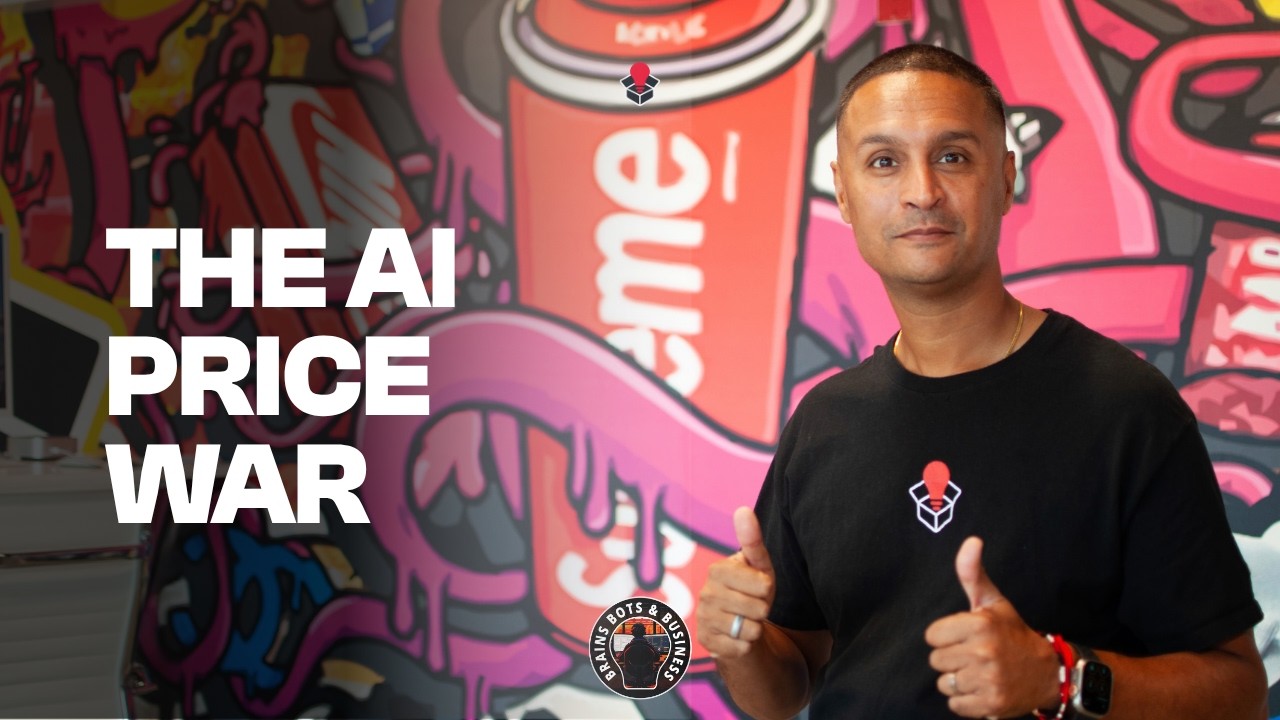
In late September 2026, OpenAI released GPT-6 Sol and GPT-6 Luna at half the per-token price of the GPT-5.6 models they replace, and Anthropic released Claude Opus 5.5 the same day. For a business, that means AI work costs less per task than it did. That's the subject of Episode 158 of Brains Bots and Business, "The AI Price War: Why GPT-6 and Claude 5.5 Just Changed the Game". As of early October 2026, here's what happened, and what it does and doesn't change.
Key takeaways
- Prices fell, but the "50%" is measured against models OpenAI had already cut in July.
- Sandeep's view: you don't have to pick a winner between Claude and GPT.
- Cheaper only matters if you automate the right jobs.
What happened in the AI price war?
OpenAI released GPT-6 Sol and GPT-6 Luna on 22 September 2026. In its "Introducing GPT-6 Sol and Luna" post, OpenAI says it is reducing API prices for Sol and Luna by 50% compared with their GPT-5.6 promotional pricing. For Sol, that takes input from $4 to $2 and output from $20 to $10 per million tokens (US dollars).
That "half" is narrower than it sounds. Those GPT-5.6 prices had already dropped in July, by 80% for Luna and 20% for Terra, per press coverage. So the new models are cheaper again, but the "half" is measured against prices that had already come down.
Anthropic released Claude Opus 5.5 the same day. Its announcement puts the price at $4 and $20 per million tokens (US dollars), 20% less than Opus 5.
| Model | Released | Launch price, per OpenAI and Anthropic |
|---|---|---|
| GPT-6 Sol | 22 September 2026 | Half the GPT-5.6 promotional price |
| GPT-6 Luna | 22 September 2026 | Half the GPT-5.6 promotional price |
| Claude Opus 5.5 | 22 September 2026 | 20% less than Opus 5 |
Does cheaper AI mean cheaper automation?
Not automatically. A per-token price is one part of what a workflow costs. The number of steps, how often it runs and how much text goes through it all count too, and so does the time your team spends checking the output. A model that costs half as much per token doesn't make a whole system cost half as much to run.
Sandeep's view is that AI is moving from an expensive experiment to a cheap, reliable utility, and that when every dollar of margin counts, the routine work is where that matters first.
Do you need to choose between Claude and GPT?
Sandeep says no. You don't need to be an AI engineer to decide between them. What you need to know is that automating routine work is more affordable than it was.
The better question is which job goes to which model. Stop Overpaying for AI With Model Routing covers sending each task to the model that fits it.
What should you do now?
Two things.
- Re-check your AI spend. If you set up a tool when prices were higher, find out what it uses now and whether it can run on a newer, cheaper model.
- Test a cheaper model on routine jobs. Pick one low-stakes task, such as summaries or email rewrites, and compare the output before you switch the rest.
The 4 Hidden Ways AI Agents Consume Your Budget is a useful checklist for where spend leaks.
FAQ
What is the AI price war?
The run of price cuts and launches between AI providers. In late September 2026, OpenAI released GPT-6 Sol and Luna at half the per-token price of the models they replace, and Anthropic released Claude Opus 5.5 at 20% less than Opus 5, per the companies' announcements.
Does cheaper AI mean cheaper automation?
Not by itself. The per-token price is one part of what a workflow costs. Steps, volume and the time spent checking the output count too.
Do I need a technical background to use AI at work?
Sandeep says no. You don't need to be an AI engineer to choose between Claude and GPT. Start with one routine job and see what it costs.
Related Links
- Watch the episode on YouTube
- The 4 Hidden Ways AI Agents Consume Your Budget
- Stop Overpaying for AI With Model Routing
- Open-Source AI Isn't Free: What Kimi K3 Means
- Stop Waiting for the Perfect AI Model
- GPT-5.6 for Business: Luna, Terra, Sol
Brains Bots and Business is where Sandeep shows you how to actually use AI to grow your company.
Sandbox Media is a marketing and AI agency in Milton, Ontario, serving businesses across the GTA and Canada.